
Where we would actually send you with a rod, from the easy jetty option to the places where you need to understand tides and croc country.
Fishing around Cairns is one of those things that looks incredibly simple until you remember where you are.
There is water everywhere.
Beaches. Estuaries. Mangroves. River mouths. Marinas. Creeks. Sand flats.
There are also crocodiles, huge tides, marine park zones, seasonal fishing closures and enough different fish species that it is very easy to have no idea what you just caught.
So this is not an expert fishing guide.
This is the version we give friends.
- Where can I go if I just want to throw a line in?
- Where would Lachlan go if he wanted something more local?
- Which spots are easy?
- Which ones require you to actually understand the tide before wandering off across a sand flat?
That is this short list. (I do want to remain married after all)
The very short version
Easiest visitor option: Palm Cove Jetty.
Best if you are already on the Northern Beaches: Half Moon Bay and Yorkeys Knob.
Productive but very definitely croc country: Barron River mouth.
Our more local low-tide option: Yule Point.
If you do not understand the tide, do not make Yule Point the place where you learn.
Check Queensland fishing rules before keeping anything.
And in crocodile habitat, stay out of the water.
First: Cairns fishing is tide fishing
If you are visiting from somewhere where you can wander down to a lake whenever you feel like it, Far North Queensland can take some adjusting.
The tide changes the entire place.
A broad sand flat can disappear.
A mangrove edge can go from dry mud to deep water.
A creek mouth that looked boring an hour ago can suddenly be moving bait and fish.
So before I tell you where to go, learn what the tide is doing that day.
You do not need to become a marine biologist.
You do need to know whether the water is coming in or going out, when the turn is, and whether the place you walked onto at low tide is going to remain accessible long enough for you to get back comfortably.
This matters everywhere in this article, but especially at Yule Point and around river mouths.
Palm Cove Jetty
If you are visiting Cairns, have a rod and want the easiest answer, go to Palm Cove Jetty.
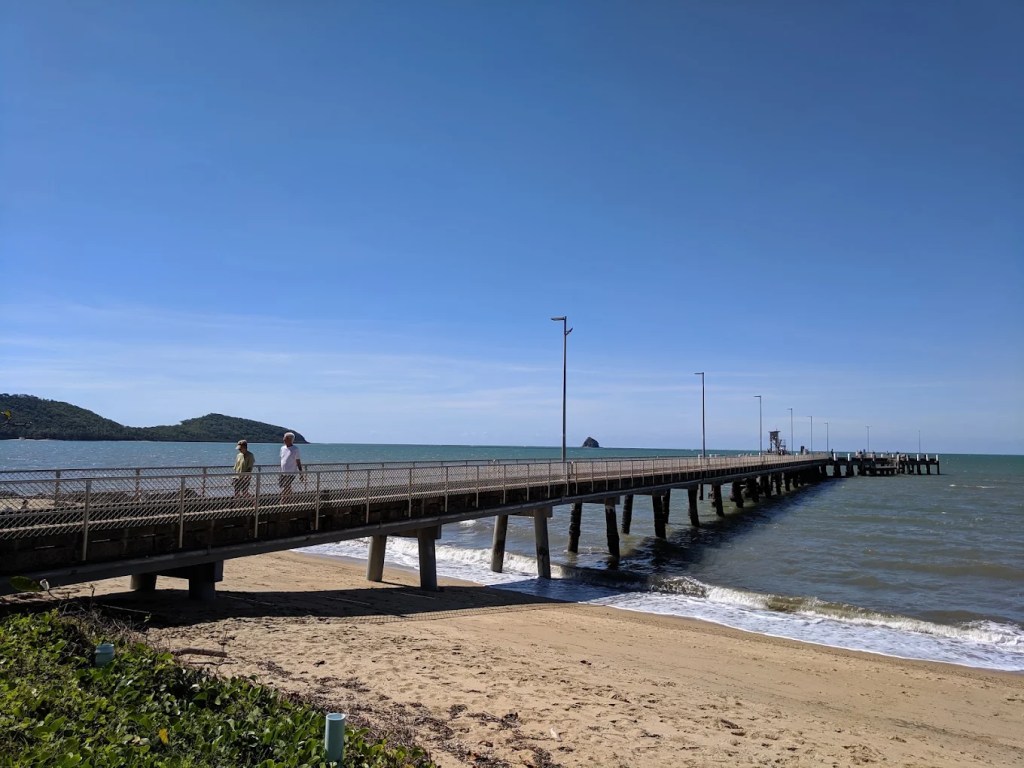
This is the one I would give somebody who does not need fishing to become an expedition.
You park in Palm Cove, walk out onto a proper concrete jetty and fish from above the water rather than trying to negotiate mud, mangroves or a riverbank.
Locals have been fishing from the jetty forever, and it is still one of the standard land-based fishing spots around Cairns.
Depending on conditions and season, people catch things like mackerel, grunter, whiting and smaller baitfish from the jetty.
You may also see people jigging for herring beneath it and using live bait for larger fish.
The nice thing for a visitor is that even if the fishing is terrible, you are still standing at Palm Cove looking over the Coral Sea toward Double Island.
That is not a bad failure mode.
Why this is the easiest option
You are on a jetty.
There is no need to wade out onto a flat.
You are close to shops, food, toilets and the rest of Palm Cove.
If somebody in your group gets bored after thirty minutes, they can go get coffee instead of sitting beside a mangrove creek questioning every life choice that brought them there.
This is also why I like it for families or people who are just trying fishing while they are in Cairns rather than designing the holiday around it.
Still, remember that Palm Cove is tropical North Queensland water.
Do not climb down into the water for a snagged lure.
Do not dangle body parts over the edge because the water looks clear.
And check the current fishing rules before you decide dinner has just arrived on your hook.
Half Moon Bay and Yorkeys Knob
If you are already staying on the Northern Beaches, this is the fishing option I would pair with the Yorkeys Knob day.

Half Moon Bay Marina sits at Yorkeys Knob, and the rock walls around the marina and creek mouth create structure that fish like (so do crocs for that reason).
This is a much more local-feeling option than Palm Cove.
You have the working marina, boats coming and going, the creek, rock walls and the whole Yorkeys Knob boating-club atmosphere around you.
Local fishing guides regularly point to the marina rock walls for barramundi, mangrove jack, flathead and trevally, particularly when baitfish and prawns are moving around the creek after rain.
Tide matters here too.
Dawn and dusk can be good times, and the turn of the tide is worth paying attention to.
But the important visitor note is the rocks.
They can be extremely slippery. I have fallen here so….wear actual shoes. And not the smooth-bottomed flip-flops you bought because you are on a tropical holiday.
And stay out of operational marina areas or anywhere current signs tell you not to be.
The bonus: eat afterward
This is also one of the rare fishing recommendations where I can very easily tell the non-fishing person what to do.
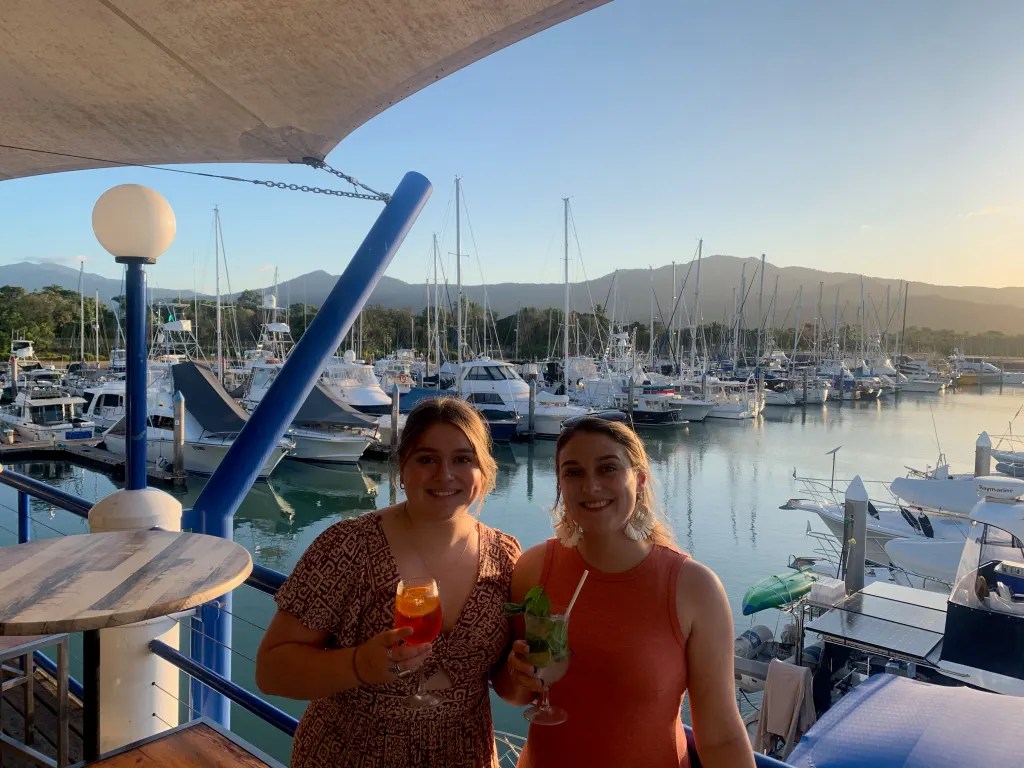
Go eat at Yorkey’s Knob Boat Club aka Boaties.
We already recommend the boating club because it has the real marina view and feels properly local.
So if one person wants to fish and the other person wants a beer overlooking the boats, this is a fairly good compromise.

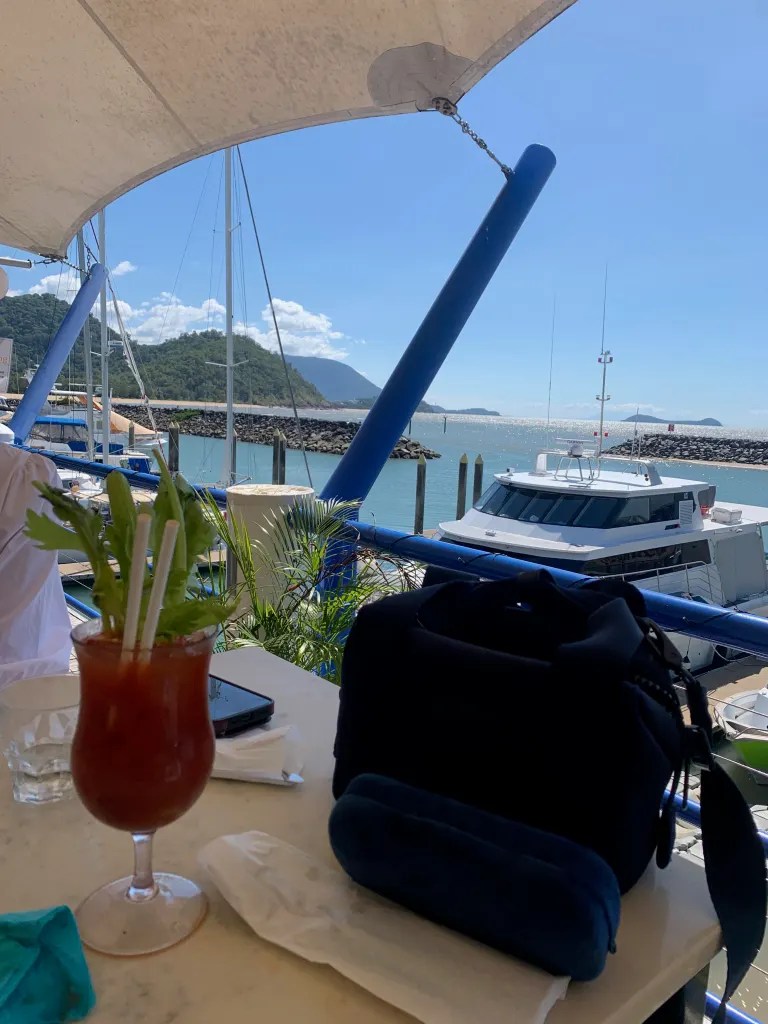
FIELD NOTE 10 — Fish early, then go get breakfast
Palm Cove and Yorkeys Knob are easier to enjoy when you are already staying on the Northern Beaches. Fish while it is cooler and around the tide you want, then go back for coffee, breakfast or a swim.
Palm Cove — the holiday version
Peppers Beach Club & Spa works for a mixed group when one person wants the jetty and everyone else wants the beach and resort atmosphere.
Yorkeys Knob — the quieter local version
A holiday rental suits readers focused on Half Moon Bay, Boaties and the marina.
Barron River mouth
Now we are leaving the “easy visitor fishing” category.
The Barron River is productive.
It is tidal, full of mangrove habitat and very close to Cairns.
The mouth and surrounding sand flats can produce whiting, bream, flathead, grunter, trevally, salmon and barramundi depending on season and conditions.
Local anglers know it well.
I would also describe the Barron River mouth with three words before sending somebody there:
This is croc country.
Not metaphorically.
Not “there was once a crocodile somewhere in the general region.”
The Barron is exactly the kind of estuary habitat saltwater crocodiles use.
So I would not send a first-time visitor down there with instructions to walk around in the shallows throwing a cast net.
Queensland’s current Crocwise advice for fishers is to stay at least five metres back from the water’s edge and never stand in the water to cast.
If you are using a cast net in croc habitat, throw it from a boat or jetty, not while standing along the edge.
And if a crocodile takes interest in your fish or bait, move.
You do not win that argument.
Who I would send here
Somebody who already fishes.
Somebody who understands tidal estuaries.
Somebody who knows that “good fishing spot” and “safe place to wander barefoot into knee-deep water” are not the same sentence in Far North Queensland.
The Barron can be a brilliant local fishing session.
It is not the place I would use to teach an eight-year-old tourist that casting is fun while everybody stands ankle-deep at the river mouth.
Yule Point
This is the local option for small reef fish.
Yule Point sits north of Oak Beach on the road toward Port Douglas, and at low tide the coast opens into broad sand, rock and mangrove flats.

This is more Lachlan’s kind of recommendation than a polished tourism stop. There are no facilities and it is a bit of a drive north up the Captain Cook Highway.
There is no giant sign saying FAMOUS CAIRNS FISHING EXPERIENCE.
You are looking for legal, safe places to pull off, watching the tide, working around the mangroves and fishing the edge as the water moves.
At low tide you can see how much habitat is out there.
- Sand flats.
- Mangrove edges.
- Rock and reef structure farther out.
- Mud-crab country.
It is the kind of place where the coast looks empty until you understand what you are looking at.
But this one comes with several giant asterisks.
Low tide means low tide
Do not walk a long way out because everything looks dry and then discover that the returning tide has changed your route back.
Know the tide before you go.
Watch what the water is doing while you are there.
And give yourself an embarrassingly generous amount of time to get back.
There is no prize for squeezing one last cast out of a flooding flat.
This is also crocodile and tiger shark habitat
Mangroves plus tidal water plus fish equals exactly the kind of habitat where you should behave as if crocodiles could be present.
Do not wade around because the water is shallow.
Do not stand at the very edge cleaning fish.
Do not leave bait or fish scraps around.
And do not assume that because you have not seen a crocodile, there is not one nearby.
Then there is marine park zoning
The Port Douglas to Yule Point coastal strip is within a conservation park zone that allows limited line fishing and crabbing.
That does not mean every possible thing you can see on the flat is yours to collect.
Marine park zoning, species rules, size limits and possession limits still apply.
So if you are thinking about crabs, oysters or anything beyond simply casting a line, check the current Queensland fishing and marine park rules first.
This is one of those places where five minutes with the zoning map before you leave is vastly preferable to trying to explain your interpretation of the rules afterward.
Why we include Yule Point at all
Because it feels local.
It is not necessarily easier than Palm Cove.
It is not necessarily more productive than the Barron on the right tide.
It is just the kind of place we would actually go because the tide looked right and we felt like wandering around the coast for a few hours.
If that sounds fun to you, you will probably like it.
If you want bathrooms, a railing and somewhere to buy an iced coffee ten metres away, go to Palm Cove.
A note about barramundi
Barramundi are one of the fish everybody wants to catch in Far North Queensland. For good reason, they’re delicious.
They also have a closed season on the Queensland east coast.
The current closure runs from 1 November through 31 January each year.
During the closure, this is not a “catch one and release it” loophole.
Queensland rules prohibit targeting barramundi during the closed season outside exempt waterways because even catch-and-release can interfere with spawning.
So if somebody tells you they know a perfect barra spot in December, check the rules before you get excited.
What about keeping fish?
Do not use this article as your fishing regulation book.
Rules change.
Different species have different minimum and maximum sizes, possession limits, no-take rules and closed seasons.
Queensland currently recommends the Qld Fishing 2.0 app for the latest recreational fishing rules.
Use it.
If you cannot confidently identify the fish, do not guess because it looks approximately dinner-sized.
Know what you caught before you keep it.
How we would choose depending on the person
You have never fished in Cairns before and want something easy
Palm Cove Jetty.
You are staying around Trinity Beach or Yorkeys Knob
Half Moon Bay.
You fish regularly and want an estuary session close to Cairns
Barron River.
You understand tides and want the more local option
Yule Point.
You want to stand knee-deep in a mangrove creek because the water looks calm
None of them.
Come back onto dry land.
What we would bring
- A rod and tackle that make sense for the fish you are targeting.
- Bait or lures.
- Pliers.
- A fish-measuring device.
- Drinking water.
- Sun protection.
- Proper shoes if rocks or mud are involved.
- A small rubbish bag for line, bait packaging and everything else you brought with you.
- The tide times already checked on your phone.
- The current Queensland fishing rules downloaded before you lose reception.
And I would not bring the assumption that every fish is legal to keep because somebody else on the jetty kept one.
Croc country rules I would actually remember
This is the safety part worth reading twice.
Crocodiles live throughout the Cairns region in rivers, estuaries, mangroves, beaches and coastal water.
The absence of a crocodile sign does not mean the absence of crocodiles.
When fishing around croc habitat, Queensland tells people to stay at least five metres back from the water, never stand in the water to cast, keep body parts away from the edge of jetties and boats, reel fish in quickly, and move if a crocodile starts showing interest.
If your lure gets snagged somewhere dangerous, lose the lure.
If a crocodile grabs the fish, lose the fish.
Fishing tackle is replaceable.
You are not.
Our actual Cairns fishing rule
Start easier than you think you need to.
If you are visiting, Palm Cove Jetty is a perfectly good fishing day.
You do not earn extra Australian points because you wandered into a mangrove estuary with no idea what the tide was doing.
If you already fish and want something more local, try Yorkeys or the Barron.
If you know your tides and want the sort of place Lachlan would actually wander around, look at Yule Point.
But wherever you go, the same rules follow you.
Know the tide.
Know the fishing rules.
Assume crocodiles could be there.
Take your rubbish with you.
And if you catch absolutely nothing, welcome to fishing.
Leave a Reply